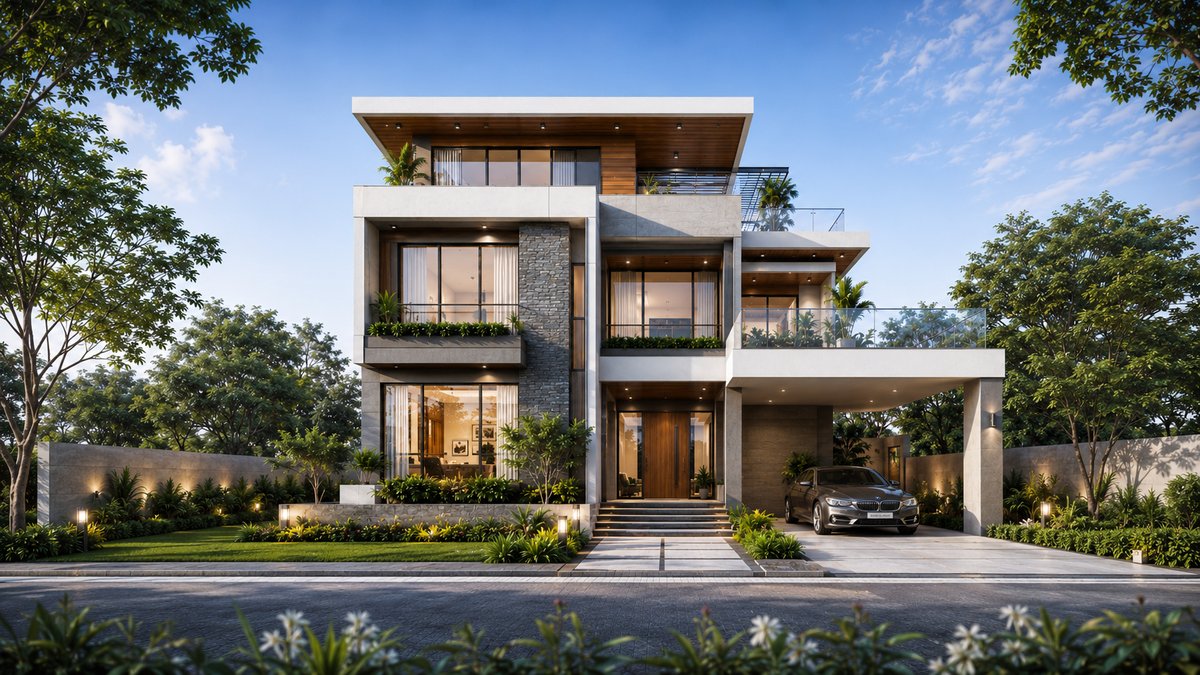
One of the first questions every homeowner asks us is simple: "How much will it cost to build my house?" It's the right question — and the honest answer is, "it depends." But that's not very helpful on its own. So in this guide, we'll break down exactly what goes into the cost of building a G+1 (ground plus one floor) home in Khagaria and across Bihar in 2026.
The short answer
For a typical 1,200 sqft plot with a G+1 home of around 1,560 sqft built-up area, construction costs in 2026 generally range from ₹28 lakh to ₹52 lakh, depending on the quality of construction you choose. Here's how that breaks down per square foot:
| Quality Tier | Rate (₹/sqft) | For 1,560 sqft |
|---|---|---|
| Basic | ₹1,500 – 1,800 | ₹23 – 28 L |
| Standard | ₹1,800 – 2,300 | ₹28 – 36 L |
| Premium | ₹2,300 – 3,200 | ₹36 – 50 L |
| Luxury | ₹3,200 – 4,500 | ₹50 – 70 L |
What goes into the cost
The per-square-foot rate isn't a single number — it bundles together everything from the foundation to the final coat of paint. The main components are:
- Structure — excavation, foundation, RCC framework, brickwork. Usually 50–55% of the cost.
- Finishes — flooring, tiling, plastering, painting, false ceilings. About 25–30%.
- Services — plumbing, electrical, sanitary fittings. Around 15–20%.
- Doors, windows & joinery — the quality here swings the cost significantly.
The costs people forget
Beyond pure construction, budget for these often-overlooked items:
- Architect & design fees — typically 4–8% of construction cost for full design.
- Building plan approval — municipal fees plus 1–2% for drawings and liaison.
- Boundary wall, gate, and landscaping.
- Overhead and underground water tanks, electrical connection, borewell.
- A contingency of 5–10% for the surprises every project encounters.
How to keep costs under control
The biggest cost savings come from good planning before construction starts — not from cutting corners during it. A well-designed home avoids waste, uses materials efficiently, and prevents the expensive mid-project changes that inflate budgets. This is exactly where a good architect pays for themselves several times over.
Our advice
Start with a clear budget, then design to it — not the other way around. Get a detailed estimate before you break ground, choose your finishes early, and work with professionals who'll be honest about trade-offs. A home is one of the biggest investments most families make; a little planning up front protects that investment for decades.
If you'd like a personalised estimate and a no-obligation conversation about your project, we're always happy to help.